
For homeowners in the Piedmont region—from the rolling hills of Lexington to the bustling neighborhoods of Winston-Salem and Salisbury—privacy is the ultimate luxury. However, achieving that “living wall” isn’t as simple as buying a tree and digging a hole. In the Carolinas, our climate is a fickle partner. With red clay that holds water like a bowl and a summer sun that can bake a root ball in hours, understanding when to plant privacy trees in NC is the difference between a thriving sanctuary and a costly mistake.
We will break down the science of the best season to plant trees in the Piedmont, explore the unique “transition zone” climate of North Carolina, and provide a step-by-step roadmap for your privacy tree installation.
Part 1: Decoding the North Carolina Climate
To understand the “when,” we must first understand the “where.” North Carolina sits in USDA Hardiness Zones 7a through 8a. This is a “transition zone,” meaning we are too south for many northern species and too north for many tropical ones.
The Piedmont Weather Cycle
In the Piedmont, we deal with:
- The “False Spring”: A warm February that tricks trees into budding, followed by a late March freeze.
- The “Carolina Bake”: July and August temperatures that frequently exceed 90°F with 80% humidity.
- The Clay Variable: Our soil is dense. In the winter, it stays cold and wet. In the summer, it turns into “brick clay.”
Because of these factors, the window for when to plant privacy trees in NC is much narrower than in the Midwest or the Deep South.
Part 2: Why Fall (Sept–Nov) is the “Pro’s Choice”
If you talk to any expert at Piedmont Privacy Trees, they will tell you that fall is the undisputed champion for planting.
1. Underground Energy vs. Above-Ground Growth
In the spring, a tree is biologically programmed to grow “up.” It wants to produce new needles and branches. This requires a massive amount of water. In the fall, the air cools, but the soil stays warm (often into late November). This allows the tree to focus 100% of its energy on root establishment.
2. The “Transpiration” Advantage
Trees “breathe” water out through their leaves (transpiration). During a Piedmont autumn, the lower temperatures and higher ambient humidity mean the tree keeps more of its internal moisture. This dramatically reduces transplant shock, a leading killer of new privacy tree installations.
Part 3: The Early Spring Window (February–March)
If you missed the autumn window, spring is your second-best bet—but it comes with a ticking clock.
The “Beat the Heat” Deadline
In North Carolina, “Spring” planting really means “Late Winter” planting. Ideally, your trees should be in the ground by the end of March. This gives them roughly 90 days to “settle” before the June heatwaves arrive.
The Importance of Sunlight Evaluation
In the spring, the sun’s angle changes rapidly. What looks like a shady spot in February might be a sun-scorched patch by May. This is why a professional sunlight evaluation is critical for spring plantings. You need to know exactly how much “afternoon bake” your new screen will receive.
Part 4: Site Preparation — Clearing the Way for Success
Before you can plant, you must prepare. A privacy screen is only as good as the ground it sits in.
1. Removing the Old to Make Room for the New
Many homeowners have “trash trees” or overgrown brush in the way of their future screen. Attempting to plant around old roots is a recipe for failure. Our tree removal services ensure you have a clean slate, while stump grinding prevents old root decay from affecting your new evergreens.
2. Navigating the “Clay Bowl”
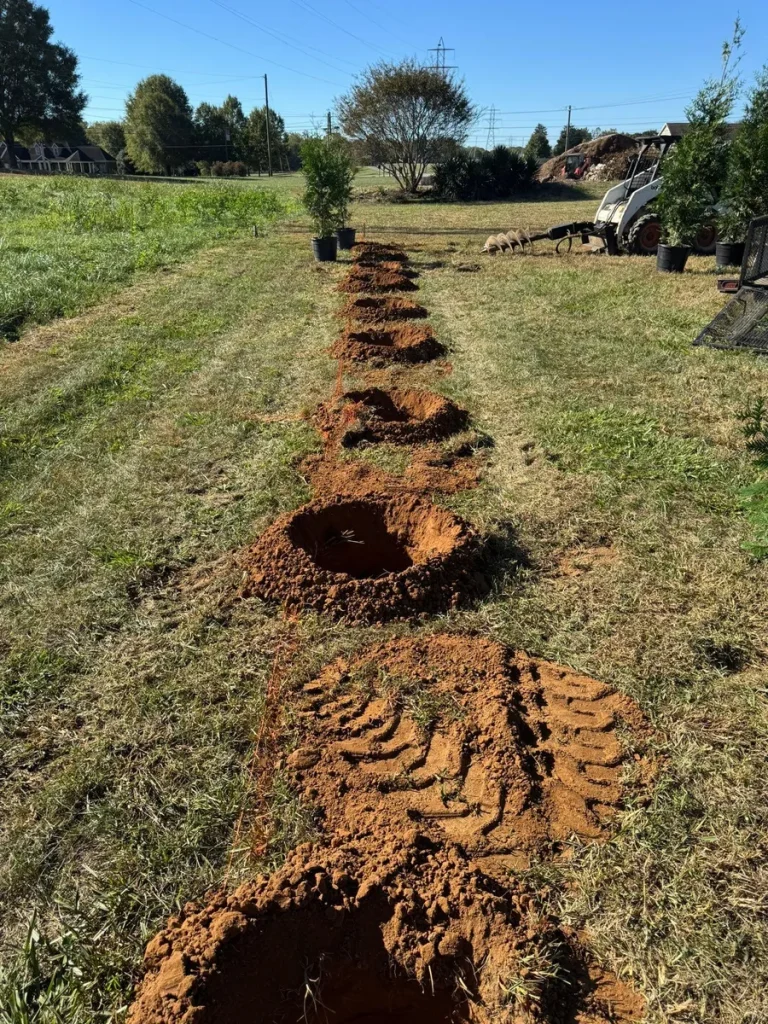
Because of our red clay, drainage is a major issue. If you dig a hole in NC clay and fill it with water, it might sit there for days. We often recommend “planting high”—positioning the root ball slightly above the soil line—and using professional landscaping services to create berms that encourage drainage.
Part 5: Species Selection for the Piedmont
Not all privacy trees have the same “clock.” Depending on your tree species selection, your planting window might shift.
Green Giant Arborvitae
- Best Time: Fall.
- Why: They are incredibly fast growers (up to 3 feet a year). Planting in the fall ensures they hit the ground running the following spring.
Nellie Stevens Holly
- Best Time: Late Fall or Early Spring.
- Why: These are “tough as nails” and handle the Piedmont’s clay better than almost any other species. Their thick, waxy leaves make them more resistant to winter windburn.
Cryptomeria (Japanese Cedar)
- Best Time: Strictly Fall.
- Why: These trees are sensitive to the NC summer sun. They need a full winter to establish roots, or they will likely “bronze” and die during their first July.
Part 6: Long-Term Maintenance — Beyond the Planting Hole
A privacy screen is a living asset. Even after a successful privacy tree installation, maintenance is key.
The First Year: Watering
For the first 12 months, your trees are on “life support.” They haven’t grown deep enough to find groundwater. A consistent drip-irrigation schedule is essential, especially during the dry NC autumns.
Pruning and Shaping
To keep a screen dense, you need regular tree trimming. This encourages “filling in” rather than just “growing up.” If you have an older screen that has become leggy or overgrown, professional trimming can often rejuvenate it without the need for full replacement.
Moving Trees
Sometimes, a homeowner realizes a tree was planted too close to a structure or a power line. This is where tree transplanting comes in. Like initial planting, the best season to plant trees in the Piedmont is also the best season to move them: the fall.
Part 7: Conclusion — Why Professional Help Matters
Building a 30-foot tall living wall is a major investment. Doing it at the wrong time of year or in the wrong soil can result in thousands of dollars in lost nursery stock.
At Piedmont Privacy Trees, we live and breathe the North Carolina seasons. We don’t just “plant trees”—we engineer privacy. From the initial sunlight evaluation to the final stump grinding of your old yard, we ensure your project is timed perfectly for the Piedmont climate.